The Status of Water Resources in Turkey Contrary to popular belief, Turkey is not a water-rich country with its growing population, developing economy, and industry. On the contrary, Turkey is progressing towards becoming "water poor."
In 2017, a country with a per capita water amount of 1,385.92 m³ is considered to be "water-stressed" [1]. The Turkish Statistical Institute predicts that the population of Turkey will reach 100 million by 2030. In this case, the per capita water amount is expected to be 1,120 m³/year [2]. This per capita consumption amount indicates that Turkey will be a country with increasing water scarcity by 2030.
Turkey's Water Resources Potential
Turkey receives an average annual rainfall of 643 mm. This amount is significantly below the world average and corresponds to an annual average of 501 billion m³ of water. More than half of this amount (274 billion m³) evaporates into the atmosphere, while 69 billion m³ seeps underground. According to the General Directorate of State Hydraulic Works, the potential surface water that can be consumed is calculated to be 98 billion m³. Of this amount, 95 billion m³ comes from rivers within the country and 3 billion m³ from rivers originating in neighboring countries. By adding the 14 billion m³ of extractable water, Turkey's total usable water potential is calculated to be 112 billion m³ [1].
Table 1. Turkey's Water Resources Potential [3] Average annual rainfall 643 mm/year Annual average rainfall amount 501 billion m³ Evaporation 274 billion m³ Groundwater 41 billion m³ Surface Water Annual Surface Flow 158 billion m³ Usable surface water 98 billion m³ Groundwater Annual extractable water amount 14 billion m³ Total usable water 112 billion m³ Usage Locations 32 billion m³ used in agriculture 7 billion m³ used for drinking water 5 billion m³ used in industry Total usable water (net) 44 billion m³ Water Resources in Turkey
 Falkenmark index valuesAccording to their values; values above 1700 indicate water richness, values between 1000-1700 indicate water stress, values between 500-1000 indicate water scarcity, and values below 500 indicate absolute scarcity. Accordingly, Table 2 presents the water resources and their conditions.There is an unequal distribution of water quantity and population worldwide. This situation is also valid within Turkey. There are disparities between the flow potential of the basins and the population benefiting from these basins. In the Marmara Region, where a dense portion of about 28% of the total population of our country lives, the basins only collect 4% of the total flow. In the basins of Meriç, Ergene, Gediz, Büyük Menderes, Burdur Lake, Akarçay, Konya, and the Asi River, the use of surface and groundwater has exceeded the capacity of water resources to renew themselves. This situation has increased pressure on the basins and posed a significant threat to the natural ecosystem.The Tigris-Euphrates Basin, which is located between Turkey and water-scarce Middle Eastern countries and has many significant water treatment projects, is the largest basin in terms of water potential consisting of many large rivers. As seen in Table 2, the Burdur and Akarçay Closed Basins have the lowest water potential compared to the other 23 basins. As shown in Table 2, it is known that some river basins are "water-rich" while others are "water-poor."Among the basins experiencing scarcity issues with Falkenmark Indicator values in the range of 500-1,000 m3/person/year are the Susurluk, North Aegean, Sakarya, and Asi basins. With the increase in population in these basins, an absolute scarcity issue is expected. Seven out of 25 basins appear to be under water stress. Among these seven basins are two large river basins, the Kızılırmak and Yeşilırmak basins. It is possible that some of the basins among these may reach "Water Scarcity" levels in the near future due to population growth, similar to other basins.Water Use in Turkey
  As seen in Table 3, there has been an approximately 50% increase in water use between 2004 and 2016. If the population growth and the expansion of the economy and industry continue, an increase in the pressure on Turkey's water resources is expected in the future [1]. Table 3. Water Use Rates in Turkey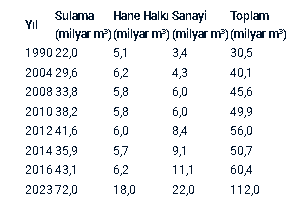
Sectoral Water Use in Turkey
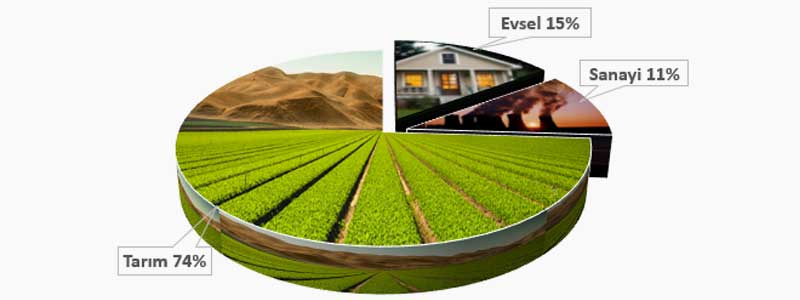
Figure 1. Water Use in Turkey
The agricultural sector has become the sector that consumes the most freshwater resources in Turkey, with 75% surface water and 66% groundwater consumption [4]. Of the total water used, 74% is for agriculture, 15% is for domestic use, and 11% is for industry.
Water Scarcity in Turkey
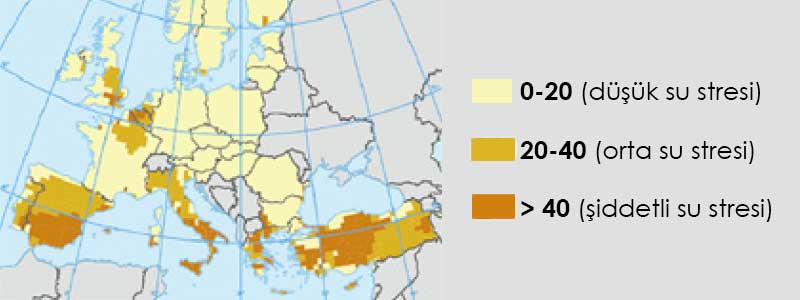
Figure 2. Water use indices in 2030
In our country, the potential surface water per capita is approximately 3,300 m³/year, while the amount of usable water per capita is 1,550 m³/year. According to TÜİK's estimates, if the population of our country reaches 100 million by 2030, the amount of usable water per capita will drop to 1,000 m³ [5;6]. It is stated that the water demand in Turkey is expected to be 183% of the current consumption by 2025. Under these conditions, serious water scarcity may be observed in some regions of Turkey, such as Thrace, Central Anatolia, and Western Anatolia. It is predicted that by 2030, water stress will exceed 40% in the inner and western regions of Turkey. In the southeastern and eastern regions, this rate is between 20-40% [4].