The Obligation to Employ Environmental Engineers in Treatment Plants Some regulations regarding the employment of environmental engineers in wastewater treatment plants have been made with the announcement numbered 30782 published on May 23, 2019, concerning the technical personnel working in wastewater treatment plants.
.jpg)
With these regulations, it has been stipulated that all technical personnel in wastewater treatment plants, including municipalities, organized industrial zones, and private enterprises, must have a degree in environmental engineering, marking a step towards the protection of water resources in our country and the necessary sacrifices to be made.
The topics included in this published communiqué can be summarized as follows:
It has been prepared based on the Water Pollution Control Regulation published in the Official Gazette dated 31/12/2004 and numbered 25687, and the Urban Wastewater Treatment Regulation published in the Official Gazette dated 8/1/2006 and numbered 26047.
The facility manager to be appointed must successfully complete the wastewater treatment facility qualification training organized by the ministry and must possess a "facility manager certificate."
Facilities are classified into 4 categories: A, B, C, and D.
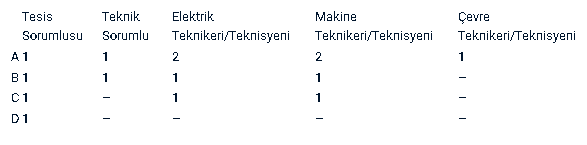
The minimum number of technical personnel required in the facilities and the duties and responsibilities of the facility managers have been explained.
What is Facility Classification?
A Class Facility: Advanced treatment plants for urban wastewater designed for a population greater than 10,000 and secondary treatment plants for a population greater than 100,000; wastewater treatment plants operated by organized industrial zone and free zone administrations with a capacity greater than 50 m3/day; and individual industrial wastewater treatment plants that perform biological and/or advanced treatment at any stage of the process with a capacity greater than 1000 m3/day.
B Class Facility: Advanced treatment plants for urban wastewater designed for a population between 2,000 and 10,000 and secondary treatment plants for a population between 10,000 and 100,000, as well as primary treatment plants for a population greater than 100,000; centralized wastewater treatment facilities for industries with a wastewater capacity below 50 m3/day, and processes with a flow rate between 50 and 1000 m3/day.
In the stage of biological and/or advanced treatment, industrial facilities and individual industrial wastewater treatment plants that perform chemical treatment with a capacity above 1000 m3/day, as well as energy production facilities that only perform physical treatment, Class C Facility: Primary and secondary treatment facilities for urban wastewater designed for a population between 2,000 and 10,000, and primary treatment facilities for a population between 10,000 and 100,000; wastewater treatment facilities that perform biological and/or advanced treatment at any stage of the process for individual industrial facilities with a wastewater capacity below 50 m3/day, and individual wastewater treatment facilities that perform chemical treatment with a capacity below 1000 m3/day, Class D Facility: Refers to natural treatment systems for urban wastewater and wastewater treatment facilities designed for a population of less than 2000, as well as wastewater treatment facilities for individual industrial facilities that only perform physical treatment. In light of the classifications specified in the Regulation, it is required that environmental engineers be employed full-time as facility managers in Class A and B treatment facilities. In Class C treatment facilities, a facility manager can work in a maximum of 5 treatment facilities, while in Class D treatment facilities, they must work in a maximum of 30 facilities (provided they are within the same boundaries). **Determination of Minimum Technical Personnel****For Urban Wastewater Treatment Facilities;****For Industrial Wastewater Treatment Facilities;****What is the Facility Manager Certificate and How is it Obtained?**To obtain a facility manager certificate, it is necessary to receive wastewater treatment facility qualification training. Individuals wishing to take this training can apply to the ministry and submit the required documents completely as requested by the ministry. **When is the Wastewater Treatment Facility Qualification Training Held?**Since the wastewater treatment facility qualification training is held once a year, individuals wishing to participate must pay attention to these dates.When the training is completed, those who have the right to succeed in the exam will be awarded the "Facility Responsible Certificate." The validity of this certificate has been determined to be 5 years. Those whose facility responsible certificate expires have the right to renew this certificate by reapplying to the ministry. Additionally, those who wish to work in a wastewater treatment facility of a higher class can also be issued a facility responsible certificate for the relevant facility upon application.**Qualifications Required for Facility Responsible**Facility responsibles working in Class A facilities must be graduates of environmental engineering, have successfully completed the training provided by the ministry, and have worked for a total of at least five (5) years in urban and/or industrial wastewater treatment facilities that perform secondary and/or advanced treatment.Facility responsibles working in Class B facilities must be graduates of environmental engineering, have successfully completed the training provided by the ministry, and have worked for a total of at least three (3) years in urban and/or industrial wastewater treatment facilities that perform secondary and/or advanced treatment.Facility responsibles working in Class C facilities must be graduates of environmental engineering, have successfully completed the training provided by the ministry, and have worked for a total of at least one (1) year in urban and/or industrial wastewater treatment facilities that perform secondary and/or advanced treatment.Facility responsibles working in Class D facilities must be graduates of environmental engineering and have successfully completed the training provided by the ministry.Facility responsibles working under the aforementioned conditions must ensure that the treatment facilities are operated in accordance with environmental regulations and the characteristics specified in the legislation. They are responsible for playing an active role in solving the problems encountered in the operation of the treatment facility and must immediately report to the relevant authorities in case of failure to meet the desired standards. All activities carried out within the scope of operating the treatment facility...Documents and information related to the facility must be kept for a period of 5 years. Additionally, they are responsible for ensuring that the documents requested by the authorized authorities are available during inspections conducted by the ministry. By working in coordination with environmental officers on these matters, steps will be taken to minimize the problems encountered in treatment plants to date and to reduce the impact of water pollution observed in our country through dedicated efforts.**What are the Inspections and Sanctions for Wastewater Treatment Plants?**Wastewater treatment plants are inspected by authorized persons appointed by the ministry. Here, it is checked whether the personnel working as the facility manager has the facility manager certificate, whether they fulfill the duties of the facility manager, and the validity period of the facility manager certificate.As a result of these inspections, if the minimum required conditions are not met, penal sanctions will be applied under Article 20 of the Environmental Law. In addition, the facility manager's certificate will be suspended for 1 month. However, if there is a situation of repeated suspension, the facility manager certificate will be revoked, and these individuals will not be allowed to apply for a new certificate within 1 year.As a result, based on the regulations regarding the employment of environmental engineers, these mandatory changes in wastewater treatment plants must be completed within 3 years from the date of publication of the communiqué on May 23, 2019.

.png)