The process of reducing pathogenic microorganisms contained in water to safe levels according to public health standards, making it safe to drink, is called water disinfection.
Although disinfection is achieved through various methods worldwide, chlorination is the most commonly used method. Chlorination is a preferred method due to its high efficiency and low cost advantages.
Natural Organic Matter
Natural Organic Matter, which can be found in all surface and groundwater, even in rainwater, forms as a result of complex biotic and abiotic reactions. DOM is a heterogeneous mixture that includes organic substances such as macromolecular humic structures, low molecular weight hydrophilic acids, proteins, fats, carboxylic acids, amino acids, carbohydrates, and hydrocarbons. The presence of DOM has significant effects on water quality in nature and engineering systems. The ability of DOM to act as proton acceptors and/or donors, its buffering capacity at pH 6, its effects on the degradation and transport of pollutants, its involvement in precipitation reactions, and its role in the dissolution of minerals mean that geochemical reactions in water systems are controlled by DOM.
Formation of Trihalomethanes
With the development of analytical methods such as gas chromatography, which is connected to mass spectrometry and allows for the detection of organic matter in water, the presence of hundreds of natural and synthetic organic compounds has been found even at low levels in water since the 1970s. It has been observed that some of these organics react with chlorine used during the disinfection process, leading to the formation of new, complex, generally harmful compounds known as disinfection by-products. For the first time in history, following the treatment of the Rhine River water, chlorination was performed, and chloroform and other trihalomethanes, defined as disinfection by-products in drinking water, were detected. Trihalomethanes are by-products with complex structures formed by the reaction of chlorine during the disinfection process.
Effects of Trihalomethanes on Human Health
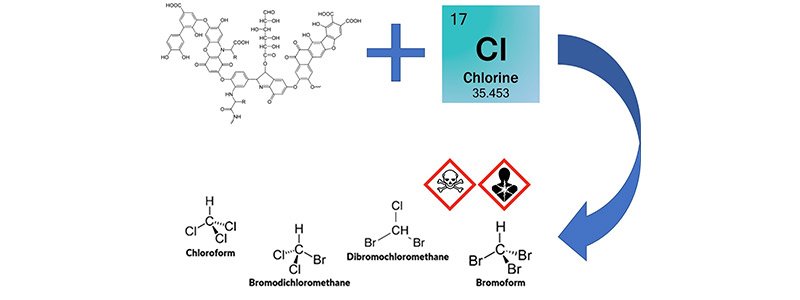
Four different Trihalomethanes, known to be the most harmful to human health, form in drinking water.
There are various types of THMs.These are:Chloroform (CHCl3)
Dichlorobromomethane (CHCl2Br)
Chlorodibromomethane (CHClBr2)
Bromoform (CHBr3)When these THM types are examined individually, findings indicating their toxicological effects on human health have been observed. When considering human exposure to THMs on a broader scale, it is known that people are more exposed to THMs not only through drinking water but also by using chlorinated tap water for cooking, washing hands and face, bathing, showering, doing laundry, cleaning, etc. Over time, various studies on the health effects of THMs have revealed that they are associated with bladder and intestinal cancer, low birth weight during pregnancy, negative effects on reproduction and development, and adverse effects on the liver, kidneys, and nervous system. The EPA examines disinfectant changes, source reduction, and treatment in three main categories to reduce and prevent Disinfection Byproducts. The methods for source reduction are mostly provided by advanced treatment processes. For this reason, they are often not preferred due to cost in most structures. Disinfectant changes are more preferred than other disinfectants because chlorine is the most suitable and efficient. Considering these situations, source reduction can increase efficiency and sustainability.