In today's world, where global water resources are gradually depleting and industrial water costs are rising, the evaluation of alternative water sources has become a necessity for facilities rather than an ecological preference...
In today's world, where global water resources are gradually depleting and industrial water costs are rising, the utilization of alternative water sources is becoming an engineering necessity for facilities rather than an ecological preference. In this context, collecting surface runoff rainwater and reclaiming it for processes or domestic use both supports environmental sustainability and minimizes the raw water costs of enterprises. A properly designed rainwater treatment plant reduces dependency on well or mains water and contributes to the protection of groundwater reserves.
The physical and chemical properties of rainwater show significant differences according to the geography where the water falls, atmospheric conditions, and the material of the collection surface (roof, asphalt, membrane). Generally having low conductivity (TDS) values, these waters may contain heavy metals originating from roof coatings, atmospheric particles, and microbiological contaminants. At this point, while designing rainwater treatment systems suitable for your facility, critical engineering approaches such as "first flush" separation are used to prevent the initial flow with the highest pollution load from entering the system, thereby reducing the treatment load.
When determining system capacity, the volume of water to be collected is calculated using the rational method in light of regional precipitation data:
Q = C.I.A In this equation:
Q: The resulting surface runoff flow rate
C: The runoff coefficient for the surface material
I: The maximum rainfall intensity of the region
A: Represents the effective collection area.
Based on the data obtained, equalization and raw water storage units of appropriate volumes are sized.
Rainwater Treatment System Technologies
The system design is shaped based on the analysis values of the collected raw water and the targeted treated water quality. As Artemis Arıtım, we integrate the following advanced treatment technologies into our processes in systems designed to modern engineering standards:
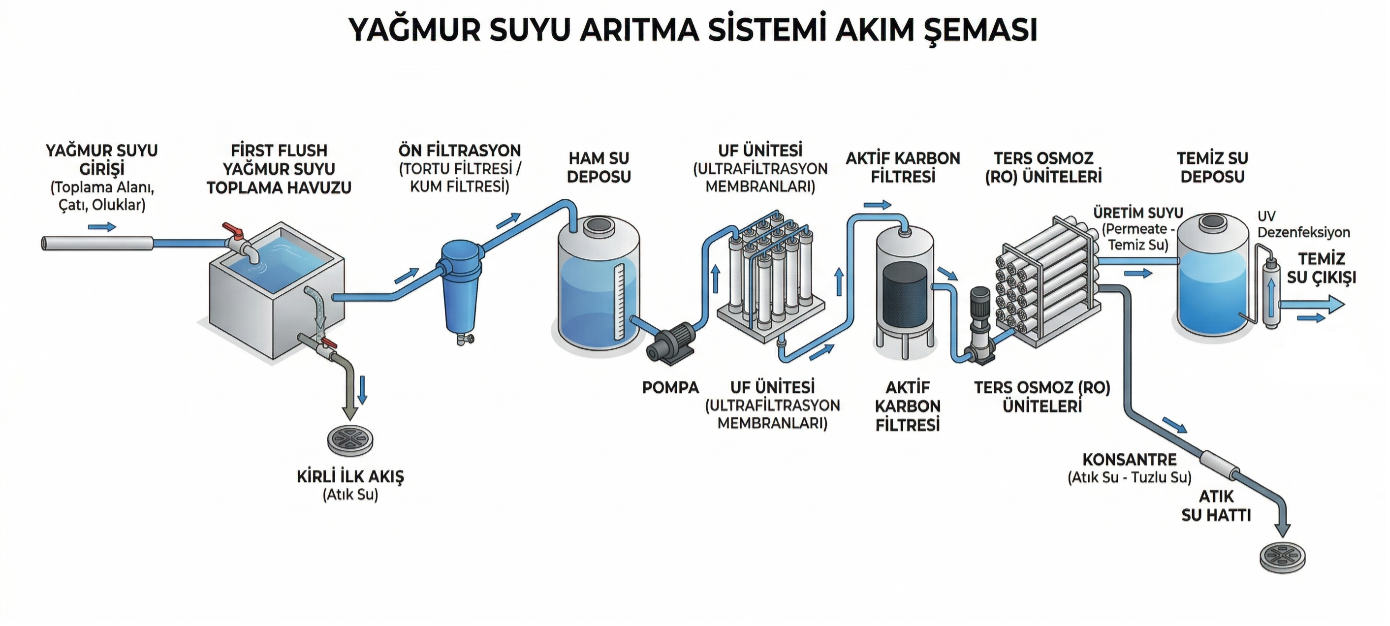
- Pre-Filtration and Mechanical Separation: Automatic or manual screen filters are used to prevent large particles, leaves, and suspended solids (TSS) from reaching pumps and other sensitive equipment.
- Multimedia Filtration: Turbidity in the water is efficiently removed through layers of anthracite, quartz sand, or active glass media with different granular properties.
- Ultrafiltration (UF): In projects requiring high-quality water production, fine particles, bacteria, and viruses are completely separated from the water using 0.01-micron precision membrane technology as a physical barrier.
- Activated Carbon: Contaminants such as oil or organic carbon loads that may originate from the rainwater collection areas are finally captured through adsorption via an activated carbon system.
- Reverse Osmosis (RO): If the produced water is to be used in sensitive processes requiring high purity and low conductivity, such as boiler feed water, Reverse Osmosis units are included in the rainwater treatment system sequence to remove dissolved inorganic ions.
- Disinfection: To prevent re-contamination of the treated water during storage and to ensure microbiological safety, UV disinfection and/or automatic dosing chlorination systems are applied.
Rainwater Treatment and Recovery Areas
Water treated with the right technology can be used safely at many points within industrial facilities and commercial buildings. The water obtained after an effective rainwater treatment process serves a wide range of purposes, such as make-up water in cooling towers, process water in industrial production lines, vehicle wash facilities, irrigation of large landscaped areas, and reservoir feeding in buildings. A rainwater treatment solution integrated into your business's daily consumption dynamics provides a rapid return on investment (ROI) with low operational (OPEX) costs.
Uninterrupted and Reliable Solutions with Artemis Arıtım
As Artemis Arıtım, with our years of engineering experience, we design long-lasting and fully automated (PLC-controlled) rainwater treatment plants that fully respond to the needs of your business. We stand by you with our expert staff throughout all stages, including detailed on-site discovery, hydraulic calculations, equipment selection, and turnkey installation.
To reduce water consumption costs at your facility, establish a sustainable infrastructure with eco-friendly approaches, and benefit from our custom project services, contact us immediately. You can fill out the contact form on our website for your requests or get information directly from our expert engineers.